in this article
- How much does it cost to produce e-learning courses by course size?
- Fixed and variable costs of a course.
- What makes the price of a course go up or down?
- How much does each type of class cost?
- Examples of scope
- Production company, in-house team, or own studio.
- How to reduce the cost of distance learning
- How to request a quote for an online course
- Frequently Asked Questions
- The volume determines the cost per lesson.
An online course consisting of 10 to 30 lessons of 10 to 30 minutes each, recorded over 1 to 4 days in a studio, generally costs between R$ 15,000 and R$ 60,000.
Short courses, with up to 15 lessons of 5 to 15 minutes each and one per day, start at around R$ 8,000; programs with more than 30 hours of lessons exceed R$ 140,000.
The biggest factor is the volume of lessons, how many fit into each recording day, and how much of the editing can be standardized.
This guide breaks down course tiers by size, including the number of lessons, hours of content, and recording days; it also explains the difference between fixed and variable costs, what factors influence the cost of each format, and how to reduce costs without sacrificing quality.
Quick summary:
- Short course (up to 15 lessons of 5 to 15 min, 1 daily): R$ 8,000 to R$ 20,000. Medium course (15 to 30 lessons of 10 to 30 min, 2 to 4 daily): R$ 20,000 to R$ 60,000.
- Courses with 30 to 100 lessons of 10 to 30 minutes each, over 4 to 8 days, cost between R$ 50,000 and R$ 150,000, while programs with more than 30 hours of lessons exceed R$ 140,000.
- A studio session lasts for 7 to 18 lessons, depending on the duration of each lesson and the instructor's preparation.
- Scenery, graphics package, and editing template are fixed costs: once purchased, they are divided across all classes.
- The cost per lesson decreases when the volume increases and the teachers arrive prepared.
- Lecture in a studio It's the format that offers the best daily return.
- Animation, external recording, and numerous graphic insertions per lesson increase the cost.
How much does it cost to produce e-learning courses by course size?
The structure only makes sense within the context provided. The table shows what typically fits into each size: number of classes, hours of completed content, and studio recording days.
| Size | Lessons and duration | Content completed | Recording days | Range |
|---|---|---|---|---|
| Short course | Up to 15 lessons of 5 to 15 minutes each. | up to 3 hours | 1 day | R$ 8 thousand to R$ 20 thousand |
| Intermediate course | 15 to 30 lessons of 10 to 30 minutes each | 4 to 10 hours | 2 to 4 days | R$ 20 thousand to R$ 60 thousand |
| Long course or trail | 30 to 100 lessons of 10 to 30 minutes each | 10 to 30 hours | 4 to 8 days | R$ 50 thousand to R$ 150 thousand |
| Large program | hundreds of lessons | more than 30 hours | several weeks of recording | above R$ 140 thousand |
The tracklist considers a lecture recorded in a studio, with a teleprompter, standard graphics package, and simple editing with insertions. The prices are based on the Brazilian market in 2026, including taxes.
The tracks overlap intentionally: a course with 20 long lessons, with lots of animation, can cost more than one with 40 short lessons recorded sequentially.
How many classes fit into a day?
A studio session lasts for 7 to 18 lessons. Lessons lasting 5 to 10 minutes, with a prepared script on the teleprompter, are at the higher end of this count; lessons of 40 minutes or more, with teacher changes and demonstrations, are at the lower end.
Therefore, the same number of lessons might require one or three days of study. When requesting a quote, specify the average duration of each lesson, not just the number of videos.
Other training formats
| Project | Common range | Larger projects |
|---|---|---|
| Animated onboarding or training video (1 video, up to 2 minutes) | R$ 6 thousand to R$ 15 thousand | above R$ 20 thousand (longer videos, original illustration, characters or 3D) |
| We only edit previously recorded classes (a batch of up to 20-30 short videos, or 1 video of up to 5 minutes). | R$ 4 thousand to R$ 15 thousand | above R$ 25 thousand (larger lots or edition with lots of animation) |
For other types of video, see How much will a video cost in 2026?.
Fixed and variable costs of a course.
Understanding this breakdown explains why a 10-lesson course doesn't cost half as much as a 20-lesson course.
| Fixed cost (done once) | Variable cost (increases with volume) |
|---|---|
| planning and script template | recording days |
| set design and set construction | editing hours per class |
| Graphic package: vignette, title cards, lower thirds | Graphic insertions and animations within lessons |
| editing and audio standard | subtitles and revisions |
| visual identity of the course | Makeup and teleprompter per day |
In a short course, fixed costs weigh heavily on each lesson. In a large program, they are diluted, and what matters becomes the revenue from each day's classes.
What makes the price of a course go up or down?
Number and duration of classes. This is the basis of the calculation. More classes require more daily allowances and more editing, but the cost per class tends to decrease.
Lessons per day. With a script on the teleprompter, prepared teachers, and a daily plan, you get much more done. In the courses of FDC Signature, There were days with more than 20 videos recorded.
Format. A lecture-based studio format is the most efficient, and screen recording is inexpensive to record but laborious to edit. Custom animation and on-site recorded practice sessions increase the cost per lesson.
Filming location. The studio has lighting, sound, and set ready. Recording at the company or in multiple cities adds setup and travel costs for each recording session.
Who writes the script? When the expert delivers the content ready for the teleprompter, pre-production is less necessary. Transforming slides and handouts into a script is a separate task.
Graphic insertions. Graphics, text, images, and animations within each lesson multiply the editing hours. Define a standard and a limit per lesson.
Revision. Experts review slowly. Extra rounds of adjustments and content changes after recording increase costs and time.
Accessibility and languages. Subtitles, sign language interpretation (starting at R$ 800 per video of up to 3 minutes) and versions in other languages are added as a cost per lesson.
How much does each type of class cost?
| Format | Relative cost per lesson | When is it worth |
|---|---|---|
| Lecture in a studio | low volume | long courses, postgraduate studies, specialists |
| Screen recording with narration | low to medium | systems training |
| Lesson with many graphic insertions. | average | technical and visual content |
| Practice recorded on location | medium to high | procedures, equipment, operation |
| Custom animation | high | processes, safety, standards |
| AI Avatar | low to medium | content that changes frequently or is in multiple languages |
Most courses combine formats: lectures as a foundation, animation for difficult concepts, and recorded practice where necessary. We compared live video and avatars in... Distance learning with live video or AI avatar.
Examples of scope
These portfolio projects show how the scope changes from one size to another. Use them to compare with your course when requesting a quote.
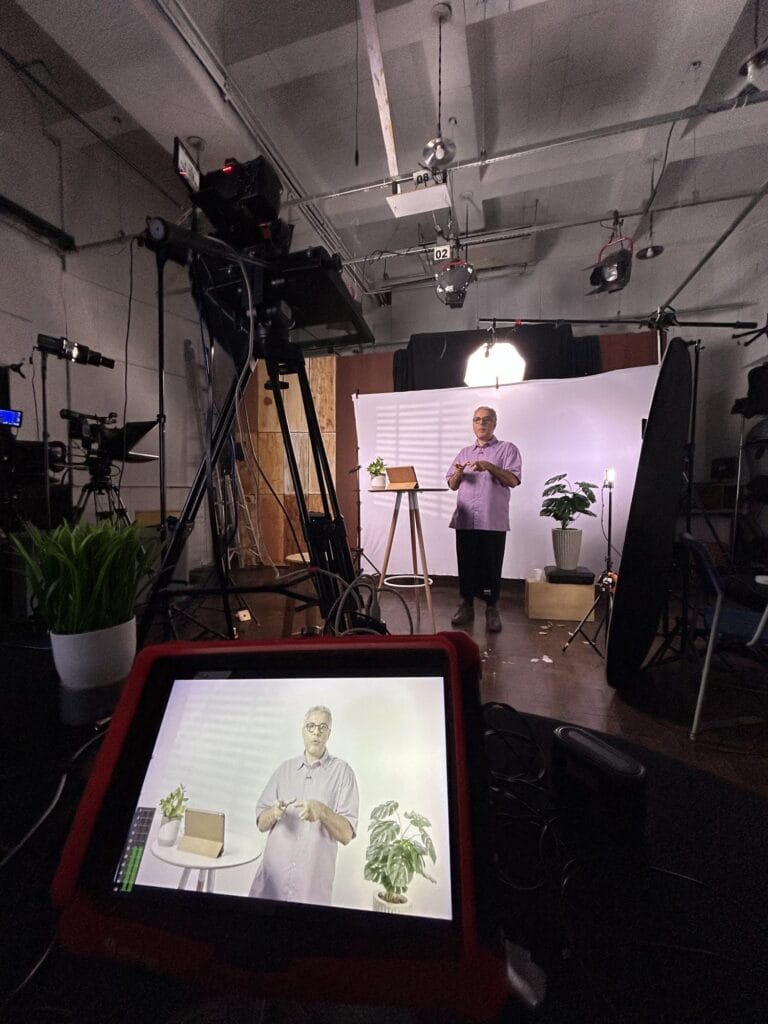
Short technical course. The Pruftechnik shaft alignment course It consists of two hours, divided between theoretical and practical videos, recorded in a studio with two cameras and its own set.
Corporate track. The Compass trail, by MRS Logística, It has several modules recorded in the Belo Horizonte studio, with graphic design, set design approved beforehand, and images of the railway operation in the editing.
Serial microlearning. For Thoughtworks, with CoolHow, it was over 90 short videos Recorded in two batches in the studio.
Large-scale program. For the Education and the Fundação Dom Cabral, In total, there were over 600 classes across more than 40 courses, with recordings made both in the studio and on location.
Production company, in-house team, or own studio.
Setting up an in-house studio requires equipment, space, maintenance, and a recording and editing team. It only pays off with high and continuous volume throughout the year.
For most companies and institutions, booking studio time in a professional studio and hiring post-production services is cheaper and more predictable. We compared the models in In-house distance learning or with a production company.. In Belo Horizonte, see the Silvertake studio.
How to reduce the cost of distance learning
- Record many lessons per day. Pre-written scripts on a teleprompter and a daily plan increase productivity.
- Prepare the experts. Those who have already read the script and know how the filming will go make fewer mistakes. See. how to drive specialists.
- Standardize the editing process. A graphics package and a limit on insertions per lesson keep editing hours under control.
- Approve the visual design before recording. Changing the scenery or intro mid-course forces students to redo lessons.
- Group courses by year. Several courses planned together share scenery, graphics package, and daily rates. See annual video budget.
- Set review deadlines. Having a course coordinator and a pre-arranged number of sessions prevents delays and rework.
How to request a quote for an online course
A simple spreadsheet with the classes will suffice. For each course, provide the following information:
- Number of classes and approximate duration of each one;
- Format of each lesson: lecture, screen-based, practical, or animation;
- How many teachers and in which cities?;
- whether the script comes ready-made or needs to be written;
- Expected level of graphic insertions;
- Subtitles, sign language, and other languages;
- platform where the classes will be published;
- Deadlines and available dates for professors.
We have a guide for define the scope of an online course and another about How to record video lessons at scale..
Frequently Asked Questions
How much does it cost to record an online course?
It depends on the size. A short course, with up to 15 lessons of 5 to 15 minutes recorded in one day, costs between R$ 8,000 and R$ 20,000.
A course consisting of 15 to 30 lessons of 10 to 30 minutes each, held 2 to 4 times a day, costs between R$ 20,000 and R$ 60,000. Programs with more than 30 hours of lessons exceed R$ 140,000.
How many recording days does a course need?
Allow 7 to 18 lessons per day. A course of 20 ten-minute lessons fits into one or two days; a course of 20 forty-minute lessons requires three or four.
Why does the cost per lesson decrease in longer courses?
Because the set design, graphics package, editing style, and planning are all done once and then divided among all the classes. Having more classes per day also reduces the recording cost per class.
How long does it take to produce an online course?
A course of approximately 20 lessons takes two to three months, from briefing to publication. The review by experts is the stage that varies the most.
Is an AI avatar cheaper than recording the teacher?
For content that changes frequently or requires multiple languages, it might be okay to skip it. For courses where the instructor's authority matters, the actual recording is worth the investment.
Are subtitles and sign language included?
It depends on the budget. Subtitles are usually charged per lesson, and sign language interpretation starts at R$ 800 per video of up to 3 minutes. Include these items in your initial quote.
Is it worthwhile to reuse old lessons?
It's worthwhile, if the content is still accurate. A new edition with the current graphic package and re-recorded segments is cheaper than recording everything again.
The volume determines the cost per lesson.
In distance learning, the price depends on the number of classes, the format, and the output of each recording day. Planning the year's courses together and arriving with ready-made scripts are the most efficient ways to reduce costs.
If you are budgeting for courses for 2027, Send the list of classes. and we will respond with a detailed quote.
Published on September 29, 2026

Samuel Silva is the co-founder and Creative Director of Silvertake Vídeo, a video production company in Belo Horizonte. He leads a team that combines creativity and technology, delivering over 7,000 videos for more than 100 companies. A graduate in Advertising from PUC Minas, Samuel specializes in marketing, creative automation, and audiovisual production.