
in this article
- 1. Context 2026: Distance education has grown, matured, and become more demanding.
- 2. The problem of AI avatars in online training and classes.
- 3. Silvertake's approach: AI as a behind-the-scenes engine, not the protagonist.
- 4. E-learning video formats that will work in 2026
- 5. How to use AI in e-learning production without losing the essence of the course.
- 6. E-learning that sells, engages, and retains: where video enters the funnel.
- 7. Practical checklist for planning your next batch of e-learning videos in 2026
- Conclusion: Technology, yes. Robot-like classroom, no.
- Next steps: how to move forward with your e-learning videos in 2026
Be honest: when you watch a 20-minute video with a somewhat stiff avatar, artificial voice, and generic backgrounds, what is your reaction?
You probably close the tab, fast-forward the video, or leave it playing on another screen while you do something else.
If neither you If you have the patience to watch this, why should your employee, your student, or, even worse, your client?
Entering 2026, the market of Distance learning, corporate education and training. This is exactly the dilemma we're experiencing. Technology has never been so accessible, the use of AI has exploded, and at the same time, it has never been so easy to create content that feels artificial, cold, and forgettable.
The good news is that it's not about being against technology. Silvertake, We are AI enthusiasts and we use it in our process. long before From the explosion of ChatGPT: in scriptwriting, content organization, review, accessibility, and even recording analysis. The difference is simple:
- AI behind the scenesTo gain scale, clarity, and efficiency;
- Real people on screenTo generate connection, trust, and genuine learning.
This article discusses how to produce e-learning content in 2026 that leverages technology but doesn't outsource the student experience to a generic avatar.
1. Context 2026: Distance education has grown, matured, and become more demanding.
Since 2015, distance education in Brazil has gone from being a supporting player to a leading player in many educational segments. Distance learning higher education courses have grown consistently, with institutions migrating a significant portion of their offerings to online or hybrid formats, both in undergraduate and postgraduate programs, as well as short courses.
Recent reports on the education market show that:
- THE personalization of learning It has become a watchword in distance education, with more flexible learning paths and a focus on adapting to the student's profile;
- Gamification, data usage, and blended learning They appear among the main trends for 2025 and 2026;
- The global educational technology market is expected to reach hundreds of billions of dollars by the next decade, with significant annual growth driven precisely by distance learning, platforms, and video content.
In other words, the competition isn't just with other institutions or companies, but with the entire experience the student already has on platforms like YouTube, independent online courses, and well-produced niche content.
If your institution or company continues to deliver training videos or online classes that look like... filmed slide, Or with an avatar that the user immediately recognizes as artificial, the risk is simple: he mentally shuts down.
That is why we position our performance as E-learning video production company focused on engagement. and also how educational video production companyThe goal is not just to "fulfill the required hours," but to ensure that the content is understood, remembered, and applied.
2. The problem of AI avatars in online training and classes.
There's nothing wrong with testing videos with AI avatars. The problem lies in pretending that this, on its own, replaces the presence of a real teacher, expert, or instructor.
When we talk about e-learning, training, or educational video content, the indiscriminate use of avatars brings some clear risks:
- Feeling of artificialityThe student realizes they are talking to "a puppet," and this reduces empathy and connection.;
- Visual and auditory fatigueVoice tone, facial expressions, and repeated gestures become tiresome more quickly than with a real person;
- Low engagement with sensitive topics.Workplace safety, compliance, health, leadership, customer service, and complex issues require nuance, a human perspective, pauses, and improvisation.;
- Wrong implicit messageWhen a company uses avatars to train employees, the employee may interpret it as "this is just to fill a quota.".
And then we return to the central question: If you don't take a video with a generic avatar seriously, why would your employee, student, or client? This doesn't mean abandoning AI, but rather placing it where it makes the most sense: in support of production, Not in place of the people.
3. Silvertake's approach: AI as a behind-the-scenes engine, not the protagonist.
At Silvertake, the reasoning is simple: There is no modern e-learning video production without technology., including, of course, all artificial intelligence tools.
Before the ChatGPT explosion in popularity, we were already using smart tools to:
- Organize large volumes of content into tracks and modules;
- To support scriptwriting, transforming raw materials into clearer didactic structures;
- Map out examples, analogies, and metaphors that make the content more accessible;
- generate alternative versions of supporting texts, exercises, and supplementary materials;
- Speed up review, captioning, and accessibility;
- To gain agility in controlling video and audio quality.
What do we it doesn't It's about outsourcing the soul of the class or training to a generic avatar. Instead, we focus on formats that combine:
- teachers, experts or real spokespeople;
- scenarios, graphics and animations which help to explain it better;
- Cutting plans, screens, practical demonstrations and everyday visual examples;
- structure designed for retention and application, not just to fill time.
This is the logic that guides our work in projects of Videos for courses and distance learning. and in corporate training videos, always adjusting the format to the reality of the institution or company.
4. E-learning video formats that will work in 2026
Okay, if we're not going to rely on generic avatars, what's the way forward? Let's look at the formats we're seeing perform best in education and training, both in educational institutions and companies.
4.1. Video lessons with a teacher in a studio and strong visual support.
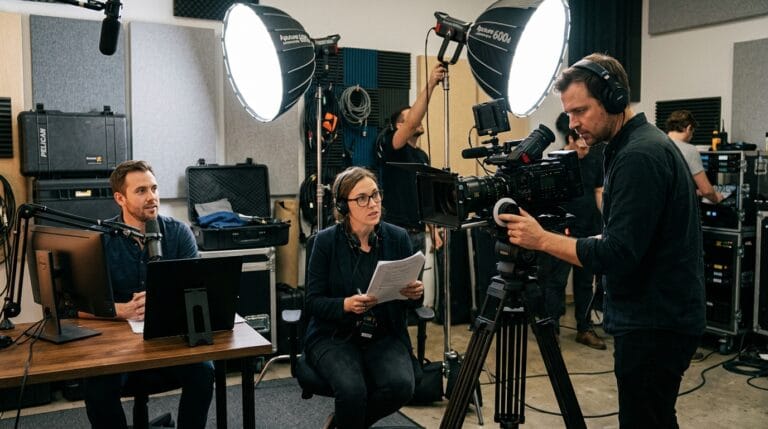
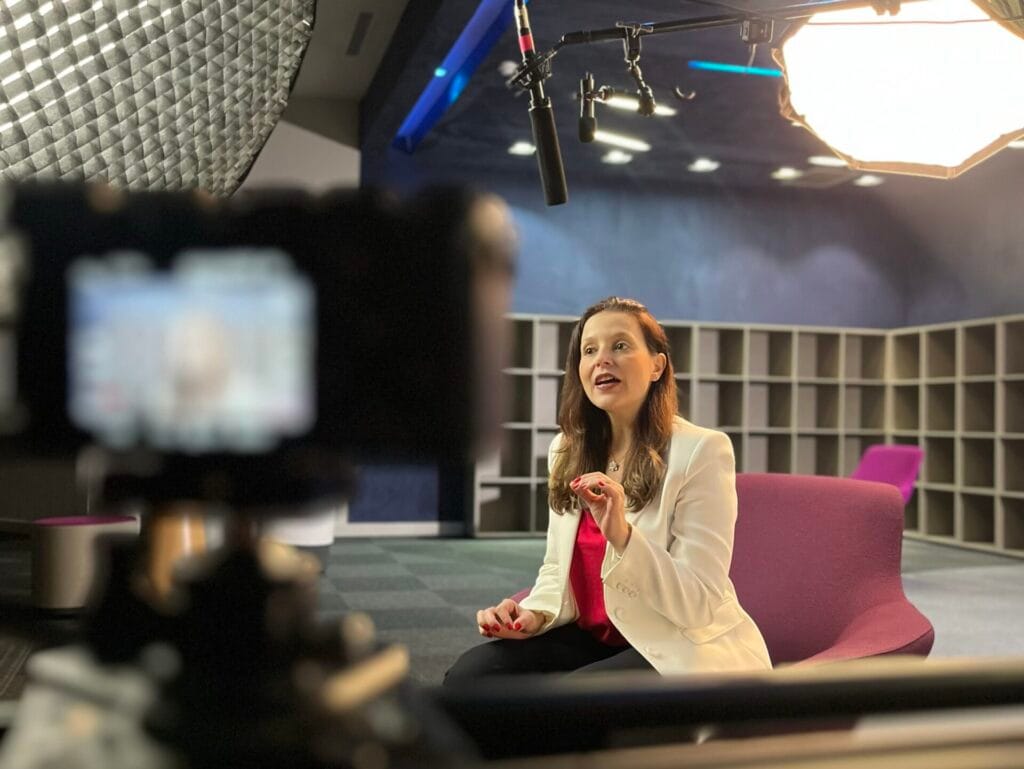
Classic for a reason: it works. The teacher or instructor appears in a well-lit studio, with professional framing, clear audio, and visual aids that truly help with understanding. No microfilmed slides.
What makes this format different:
- Content organized in shorter modules, Instead of one giant, single lesson;
- Use of physical scenarios that engage with the visual identity of the institution or company;
- Insertion of graphics, text and animated illustrations Specific points to reinforce concepts.
Examples of this appear in projects such as the online course for the Troposlab, focused on corporate education and innovation, and on the video lessons produced for the Ipemig and Baptist College, with over 500 classes for courses in Theology, Pedagogy, and Law, including accessibility in Libras (Brazilian Sign Language).
4.2. Corporate training with practical demonstrations
For technical and operational training, the formula "person explaining + screen showing + real-world practice" tends to be much more effective than an avatar narrating theory.
In projects such as Online distance learning training for Pruftechnik, For example, the focus is on demonstrating the correct use of equipment in practice, with a camera following the instructor and details of the equipment, as well as supplementary graphics and text.
In training sessions for internal teams, we can combine:
- explanation from the instructor or expert;
- Screenshot capture for systems, platforms, or software;
- Recordings in a real work environment;
- Staged simulations with actors are used when it makes sense to illustrate behaviors or situations.
It's the cleanest way to show how to, Don't just dwell on "what you should do.".
4.3. Modular learning paths and microlearning
Another strong trend for 2026 is working with distance learning and training in modular tracks, with shorter videos and very clear objectives for each lesson.
This applies to both institutions and companies. Instead of 40 minutes of video at once, we organize a sequence of content ranging from 5 to 12 minutes, each with:
- a defined learning objective;
- well-chosen examples and cases;
- A conclusion that revisits the main points.
Projects such as the production of 12 video lessons for the Cora, Customized scenarios and graphics illustrate this reasoning well: dense content divided into digestible and visually consistent blocks.
4.4. Hybrid content: live teacher + animation + motion
Not everything needs to be a "standing teacher" lecture or a full-screen animated video lesson. Often, the best format is a... hybrid.
Some powerful combinations:
- teacher on stage + animated blocks to explain abstract concepts;
- Real voice of the expert + motion graphics to illustrate flows, processes and models;
- Part of the narrative includes testimonials and real scenes, as we did in projects for the education sector, such as... Matific institutional video or from Animated video for the Bernoulli Education System..
This mix helps maintain attention, reinforce important points, and make the content more memorable, without sacrificing... human presence.
5. How to use AI in e-learning production without losing the essence of the course.
If the problem isn't the technology itself, how can we use AI to support the production of e-learning content and training in 2026?
Here are some possibilities we use daily at Silvertake:
- Content organization: transform manuals, handouts, and PDFs into lesson outlines, with modules and topics;
- Support for scriptwriting: to generate initial versions of scripts that are then refined by the teaching staff and specialists;
- Translation of technical language: adapting very dense content into more accessible language, without losing rigor;
- Variations of examples: create alternative examples for different audiences (undergraduate student, manager, field technician);
- Accessibility: accelerate captioning, create content descriptions, and support clarity reviews;
- Quality control: to help identify low audio points, confusing sections, or repetitions.
Notice that in all these uses, AI is... behind Regarding the content, supporting the education, communication, and video team. The face that appears on the screen remains that of a teacher, instructor, leader, or actor prepared to represent the message naturally.
With this, the institution or company wins on both sides:
- a AI efficiency to organize, script, and revise;
- a human credibility when it comes to teaching, engaging, and persuading.
6. E-learning that sells, engages, and retains: where video enters the funnel.
Another important point for 2026 is understanding that e-learning videos aren't just for fulfilling academic requirements or running internal training. They can also be part of... lead generation and retention funnel.
6.1. Top of the funnel: attract and explain the value proposition.
At the top of the funnel, institutional and explanatory videos help to position the institution or company, showcase its unique selling points, and translate more technical proposals into simple language.
This is the case with projects such as Institutional video for IGTI, focused on technological education, or of institutional of Matific, which combines testimonials, real scenes, and animation to explain the platform.
6.2. Middle of the funnel: sample lessons and demonstration content
This includes open video lessons, training excerpts, recordings of practical demonstrations, and even short series of applicable content. It's the moment when the student or client thinks:
“"If the free content is already this good, imagine the full course.".
At this point, formats like the ones we use in content videos They help to establish authority, teach something useful, and at the same time, make the quality standard of distance learning clear.
6.3. Bottom of the funnel and after-sales: training that generates results.
After enrollment, contracting a service, or purchasing a complex product, e-learning video becomes a tool for:
- onboarding of students and clients;
- technical training from internal teams;
- reduction of supportThe better the training content, the fewer operational questions reach the customer service team.;
- loyalty and retentionThose who feel supported in using the solution tend to stay longer.
In other words, a well-made e-learning video is also revenue strategy, not just in education.
7. Practical checklist for planning your next batch of e-learning videos in 2026
To move this discussion from the conceptual level to the practical level, here's a straightforward checklist for you to use in your next e-learning project or video training:
- publicWho will be watching? Students, staff, clients, partners?
- objectiveWhat does this person need to be able to do after learning the content? Understand, apply, decide, operate?
- formatDoes a studio-based video lesson, hands-on training, screen-to-face interaction, animation, or a hybrid approach make more sense?
- workload vs. screen timeHow can we break down content into smaller modules instead of long, tedious videos?
- visual resourcesWhich charts, screens, demonstrations, or animations truly help in understanding the subject?
- use of iaWhere can AI provide support without taking the place of the teacher or instructor?
- deployment planHow can these videos be repurposed for communication, lead generation, after-sales service, and ongoing training?
If you would like support in structuring this into a concrete project, our page of e-learning video production company and of video production company for training They already provide a good overview of the formats and processes we can work on together.
Conclusion: Technology, yes. Robot-like classroom, no.
For 2026, the message is clear: It's not enough to use AI, you have to use it well..
If your student, employee, or client perceives the video as just another generic piece made to "fill a quota," engagement drops. And in education and development, low engagement means shallow learning, weak application, and limited return.
On the other hand, when you combine:
- Real teachers, experts, and instructors, speaking clearly;
- Well-thought-out visual resources and professional production;
- Intelligent use of AI to achieve scale, consistency, and quality;
E-learning videos are no longer an obligation but a competitive differentiator, both for educational institutions and for companies that take training seriously.
In the Silvertake, Our focus is precisely this: to produce videos that work in practice, with quality, creativity, and scale, whether in... educational projects, whether in Content for internal training. or complete distance learning courses.
Next steps: how to move forward with your e-learning videos in 2026
If you want to update your e-learning or video training for this new scenario, here are three practical ways to get started:
- See examples in practice: Explore the Silvertake's complete portfolio and check out projects like the Online distance learning course for Ipemig and Faculdade Batista., the Troposlab online course, the Pruftechnik online training and the video lessons of Cora.
- Talk to our producers: Schedule a quick chat to understand which format combination makes the most sense for your reality in 2026:
schedule a meeting with Silvertake. - Send a simple briefing: If you already have a course, learning path, or training program in mind, please send a summary of the context and objectives through our contact form:
Contact Silvertake using the contact form..
With good planning, the right technology used in the right place, and a production that respects the intelligence of the viewer, your e-learning content can move beyond generic avatars and become a real asset for learning, performance, and results.
Published on December 5, 2025

Samuel Silva is the co-founder and Creative Director of Silvertake Vídeo, a video production company in Belo Horizonte. He leads a team that combines creativity and technology, delivering over 7,000 videos for more than 100 companies. A graduate in Advertising from PUC Minas, Samuel specializes in marketing, creative automation, and audiovisual production.