in this article
When an executive freezes on camera, the problem is almost never the camera. It's the crowded room, the script memorized the night before, and the feeling that every word will be judged by the board.
We learned this over more than a decade recording CEOs. The same director who runs a paperless meeting becomes a different person when the red light comes on, and asking him to... to relax It doesn't solve anything. What unlocks the problem is the work of the team before recording, during recording, and around the set.
Why do people who speak well in meetings freeze up on set?
In meetings, the executive receives feedback all the time. Someone nods in agreement, another takes notes, a third interrupts with a question. His speech adjusts to this without him even realizing it.
In front of the lens, that feedback disappears. He speaks into a black glass, with a bright light in his face, knowing that it will be recorded, and his brain goes into oral exam mode.
Therefore, executive direction is, for the most part, about recreating the conversation that the camera captured of him. Public speaking techniques are of little help; what helps is... conversation context.
Before REC: room, agenda and script
The room needs to be emptied.
On set, the executive's biggest enemy is often the company itself. Marketing manager, advisor, someone from legal, curious interns at the door: each additional person is another pair of eyes assessing.
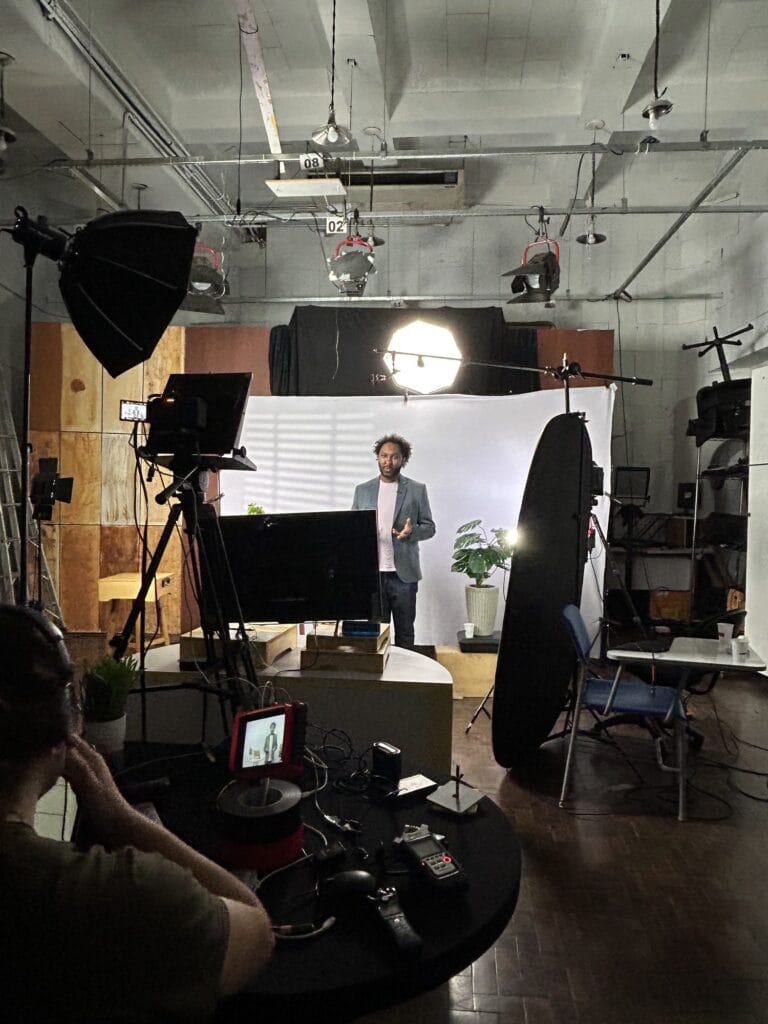
We agreed on this during pre-production: the technical team, the director, and at most one person from the client will be present, monitoring the production from outside the director's field of vision. Anyone who wants to give their opinion speaks to the director, never directly to the executive between takes.
If the recording takes place at headquarters, the problem doubles, because the set becomes a corridor. We've compiled the most common pitfalls in... recording errors at company headquarters.
His schedule matters more than the lighting.
An executive who comes straight from a difficult meeting brings the meeting with them. We request the first slot of the day or a breathing space before the recording.
Lighting, sound, and framing have already been tested with a stunt double from the crew when he enters. Every minute he spends still in the chair, with a microphone on his lapel and people moving around him, increases the tension.
A script that sounds too good to be true is a trap.
Many teams send the final script the night before, and the executive spends the night memorizing it. On set, he recites it, and any forgotten word causes panic.
We prefer to work with Topics and anchor phrasesWhat needs to be said, in what order, and the few phrases that have to be precise, such as numbers, product names, and the closing statement. The rest he says in his own way.
If the format requires reading, that also needs practice. We have a guide on that. how to record with a teleprompter without a fixed stare.
During filming: what the director does to unlock
Record the warm-up
The camera is already rolling when we start talking about the project, the team, the week. He doesn't know that this could become a take, and sometimes it does become the best part of the day.
Replace monologue with a question.
Instead of asking, “Now tell me about your expansion strategy,” the director asks, “If a new client wanted to know why you’re opening this operation, what would you say?” The answer comes out in a conversational tone.
In the edited version, the question disappears, leaving only the answer. To make this work, we agreed beforehand that he would answer in a complete sentence, returning to the context.
Give him a face to look at.
When the video requires looking directly at the lens, the director stays close to the camera, at eye level, reacting to what it says. In an interview, the gaze goes to the director, slightly out of the lens, and he never speaks into empty space.
Never say “relax”
That's the phrase that most often freezes people on set, because it confirms that they seem tense. Specific and short feedback works better: “That was great, now the same idea in half the time.”.
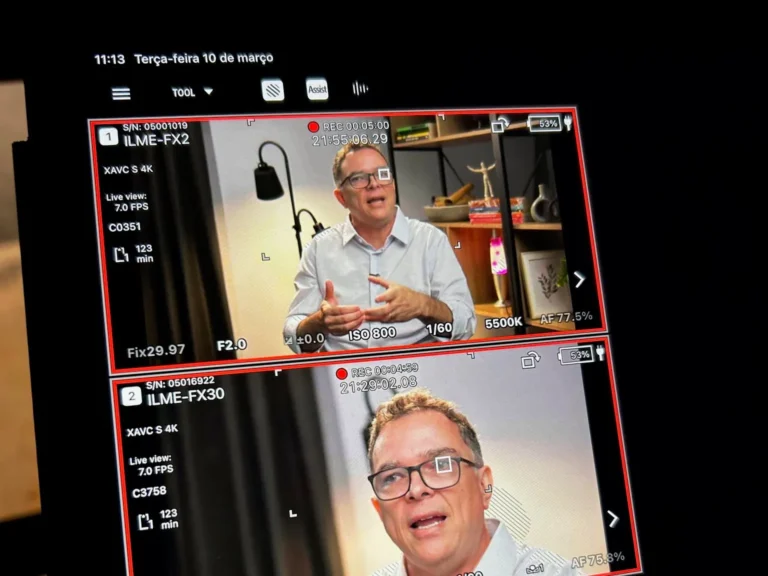
We also don't show the monitor in the middle of the recording. An executive who sees himself on the playback starts correcting his hair, posture, and tone, and stops thinking about the content.
Short blocks and two cameras
No one needs to speak for two minutes straight without making a mistake. We record one idea at a time, with a second camera in a different frame, so that the transition between segments looks natural in the editing process.
That confidence is evident in a person's face. Those who know they can stop and start again without incurring costs make far fewer mistakes.
What the client's team does without realizing it.
A large part of the gridlock stems from good intentions. These are the behaviors we see most often:
- Rewrite the text on set, in front of him, for each take.
- Commenting on the performance aloud, something like “it's kind of serious, isn't it?”.
- To squeeze the recording in between two meetings.
- Ask him to imitate the spokesperson from another company's video.
If you're the manager coordinating this recording, on set you're the host, not the evaluator. Adjustments go to the director, and the director translates them into simple instructions.
Much of this can be resolved in technical recording visit, when you can see where he's going to sit, who's around, and how much time he actually has available.
How Silvertake does it
Recording leadership is a central part of our work in corporate video production and corporate. Pre-production protects the executive's schedule, the set is ready before arrival, and direction happens through conversation, with editing taking advantage of naturalness instead of forcing the script.
You Videos announcing LOG Commercial Properties' quarterly results. They are recorded at the company's headquarters in Belo Horizonte, with a full version and a vertical version for social media. In them, the spokesperson needs to be accurate with the numbers and, at the same time, sound like someone conversing with the market.
With technical experts, the challenge is similar. PAAES-CE diagnostic videos, In the recordings with Cobrape specialists for the public hearings in Ceará, the management maintained technical rigor without sacrificing clarity for the listeners.
Your executive doesn't need to become a presenter.
No one wants to turn the CEO into a news anchor. The goal is for him to appear on video as he does in a good meeting: confident, clear, and like himself.
If you have a recording session with leadership on your calendar and you can already imagine the executive freezing up, talk to us before the day. Send a briefing for our team And we had a quick chat to outline the pre-production.
Good camera and nice lighting are enough. What makes the video work is the person in front of it being able to be themselves.
Published on November 19, 2026

Samuel Silva is the co-founder and Creative Director of Silvertake Vídeo, a video production company in Belo Horizonte. He leads a team that combines creativity and technology, delivering over 7,000 videos for more than 100 companies. A graduate in Advertising from PUC Minas, Samuel specializes in marketing, creative automation, and audiovisual production.