
in this article
A production company with a freelance team isn't a red flag. The real red flag is when no one can explain who's responsible for your video when the camera is off.
Many purchasing and marketing professionals ask competitors, “Is your team hired under CLT (Brazilian labor law) contracts?” This question misinterprets the situation. A successful production process depends on... a process that binds people, ...and their hiring practices have little impact on this.
Why almost every set works this way
Open the credits of any film, series, or campaign and you'll see dozens of names. Most are professionals who work across projects: director of photography, sound recordist, gaffer, makeup artist, camera assistant, editor, and motion designer.
The reason is practical. A video in a factory requires one team, a series of video lessons in a studio requires another, and a product motion graphics project might not even have a set. Keeping all these hired professionals idle between projects increases costs and doesn't improve anything.
For you, this means that the production company can assign the right specialist to your scope, instead of fitting your project into whichever team they have available that week.
Before the day's work: how the team is assembled
The unchanging core
Every serious production has a fixed project manager. This is the person who received your briefing, approved the script with you, and will be there for the final delivery. It could be the director or the executive producer, and the title matters little.
This axis doesn't change mid-way. It's what translates what you said in the meeting into the language of the set.
The experts who come in by scope
Around this central axis, the team is designed based on the script. If there's an interview with three executives in a meeting room, a sound technician who knows the typical echo of a corporate environment comes in.
Filming on a factory floor requires someone accustomed to PPE and safety protocols. This setup is finalized in pre-production, with a defined name and role. If the production company can't say who will be on set two days in advance, something is amiss.
On set: what keeps a team together that doesn't see each other every day?
The attendance sheet
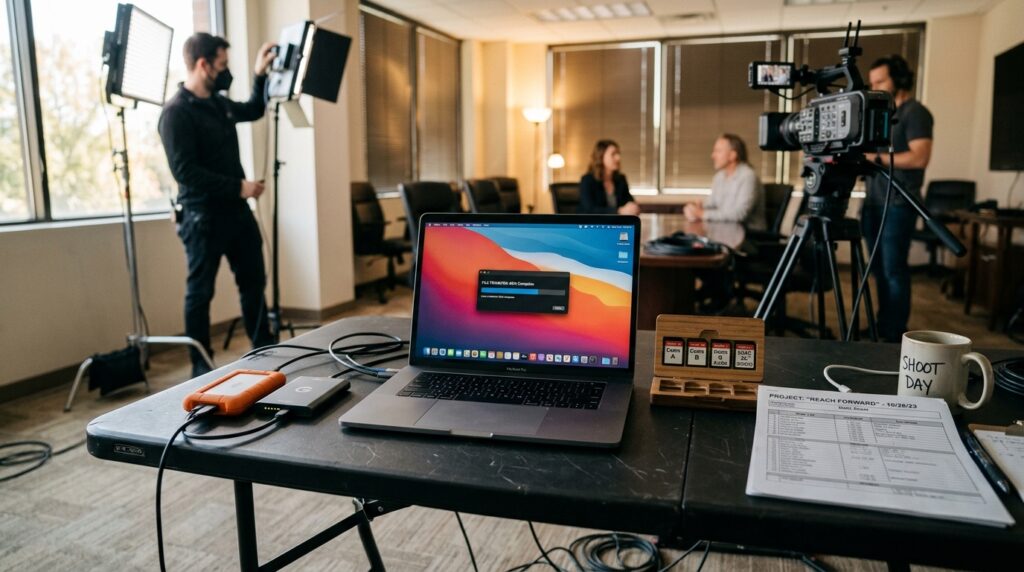
The day before, each person receives the same attendance sheet: address, arrival time by role, scene order, contact information for the person receiving the team at their company, and location restrictions. It seems like bureaucracy, but it's what prevents the makeup artist from arriving after the first executive.
An experienced freelance professional lives off of call sheets. He works with several production companies and knows that his reputation depends on arriving on time and already knowing the plan.
A single decision point
On set, you only have one point of contact. You don't need to ask the photographer for lighting adjustments or discuss the air conditioning noise with the sound technician. You talk to the director, and he distributes the information.
This hierarchy avoids the scenario of five people giving their opinions on the CEO's framing while his agenda slips away.
The memory card cannot be removed without a copy being made.
One of the most tense moments of any shooting day happens away from the client's eyes: the unloading of the footage. The card is removed from the camera and transferred to two different disks. The copy is checked, and only then is the card formatted.
Along goes combined nomenclature of folders and takes. With it, an editor who wasn't on set can find the best answer from their finance director without watching three hours of raw footage.
The real risks of a freelance team (and how to check them)
The model has points of attention, and to say otherwise would be dishonest. All of them can be resolved with objective questions before finalizing.
- Confidentiality: Ask if each professional who goes to the set signs a confidentiality agreement with the production company. This is important for recording the final product, the release, or behind-the-scenes footage.
- Responsibility: Your contract is with the production company, and they are responsible for deadlines, revisions, and deliverables, not each freelancer.
- Files: The raw footage cannot reside on the editor's personal hard drive. Ask where the material is stored and for how long.
- Continuity: In recurring projects, the same language needs to survive team changes, which requires a documented standard.
If the difference between hiring a production company and assembling a team of freelance professionals is still unclear, this comparison between audiovisual producer and freelancer help. Also, read the clauses carefully. rework and deliverables in the production company contract.
Regarding the files, we show what to require in how to switch production companies without losing your original files.
How Silvertake does it
In over a decade of recording CEOs, we've learned that the client isn't concerned with how the team is hired. They want to know if the week 12 video will look the same as the week 1 video.
Therefore, each project has a person responsible from briefing to delivery, and the visual standard becomes a document: camera position, lighting temperature, set design, graphics package, and file naming convention. Anyone joining the project receives this standard before even stepping onto the set.
Same pattern in three cities
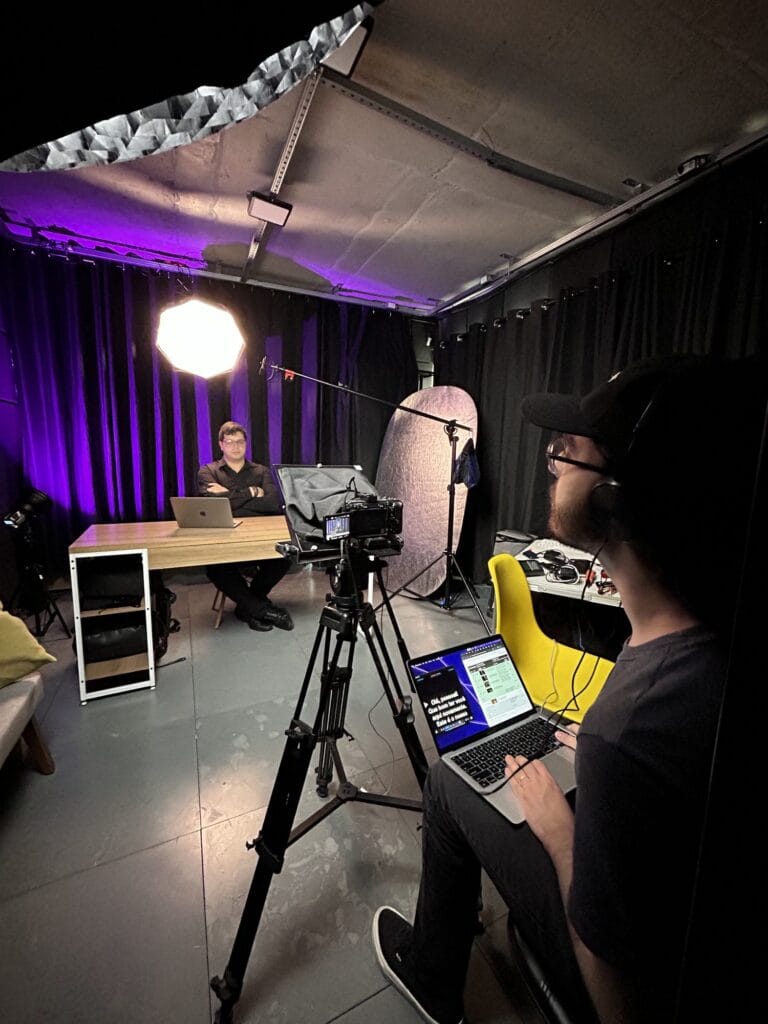
Us FDC Signature online courses, The video lessons were recorded in studios in São Paulo, Belo Horizonte, and Brasília, using a teleprompter and the graphic package from the Dom Cabral Foundation. The student cannot tell in which of the three cities each lesson was recorded.
Outside expert, same flow
In the Compass MRS onboarding path, Over 30 videos were recorded in the Belo Horizonte studio in partnership with learning designer Nanda Miranda. She joined the project as an external specialist and followed the same scriptwriting, recording, and approval process as the rest of the team.
It is this fit that makes projects... Video for courses and distance learning. and corporate video production They can run without you needing to manage who's on the other end.
Ask about the process, not the badge.
In the next competition, replace the question about the hiring process with three other questions: Who is responsible for my project from start to finish? Who will be on set? Where will my files be kept after delivery?
If you'd like to see how this works in your own project, send a briefing to our team via [contact information would go here]. Silvertake contact And schedule a quick chat.
A good video is made by many people. Your job is to ensure they are all looking in the same direction.
Published on November 26, 2026

Samuel Silva is the co-founder and Creative Director of Silvertake Vídeo, a video production company in Belo Horizonte. He leads a team that combines creativity and technology, delivering over 7,000 videos for more than 100 companies. A graduate in Advertising from PUC Minas, Samuel specializes in marketing, creative automation, and audiovisual production.