
in this article
The film crew arrives at the factory gate. They're wearing shorts, black t-shirts, and canvas sneakers. The occupational safety technician crosses his arms and forbids them entry. The day's pay is lost before anyone even turns on the camera.
One video recording in industry There's no room for amateurism. Sparks, forklift movement, extreme noise, and heavy machinery demand much more than good framing. They require documentary and physical precision.
Hiring a production company that is unfamiliar with Health, Safety, and Environment (HSE) protocols is a huge legal risk for your brand. If a camera operator is injured on your production line without proper insurance, the liability falls on your company.
The basics of safety: Mandatory PPE in the industrial setting.
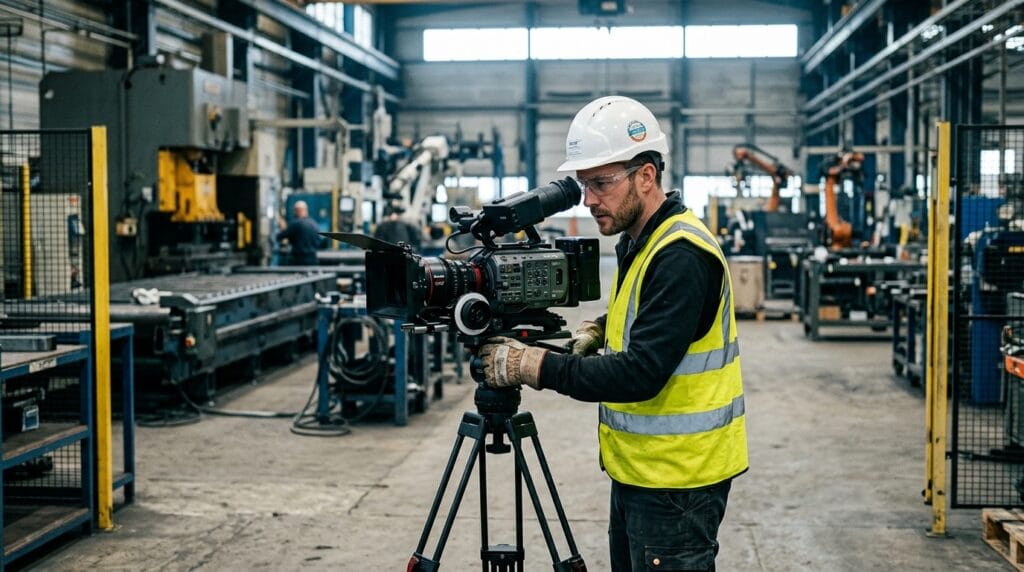
Unlike a traditional corporate set, the factory floor dictates what the video crew can wear and carry. Footage must adapt to the operational routine, never the other way around.
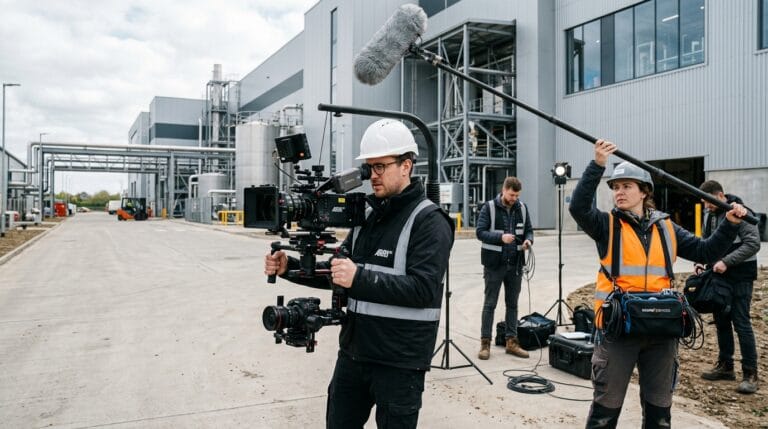
To ensure that your corporate video checklist Do not run into problems at the entrance; the audiovisual production company must present and use personal protective equipment (PPE) at all times.
| Equipment (PPE) | Mandatory Use | Risk Avoided in Recording |
|---|---|---|
| Helmet with chin strap | Head stuck | Impact on the operator who walks while looking at the screen. |
| Protective eyewear | Eyes | Damage caused by sparks or debris near the camera lens. |
| Safety boot | Feet | Crushing by moving loads or forklifts. |
| Earplugs | Ears | Hearing loss in sound crews in areas of extreme noise. |
| Reflective vest | Stem | A pedestrian being run over, ensuring high visibility for the videographer. |
In addition to the crew's attire, the video equipment itself requires adaptation. Tripods cannot obstruct escape routes. Cameras must use robust safety straps. And external lights need insulated cabling to prevent the risk of tripping or short circuits.
Insurance: the legal barrier between video and liability.
Authorizing the entry of third parties without insurance coverage is a serious compliance failure. When contracting a production company for the industrial sector, three types of insurance policies need to be on the table during negotiations.
1. Civil Liability Insurance (RC)
RC insurance protects your company if the video crew causes structural damage or disrupts operations. If a poorly positioned tripod drops a critical piece of equipment and interrupts the line, the insurance covers the costs of the failure without burdening your budget.
2. Life and Personal Accident Insurance
The production company's team must be insured against workplace accidents. You need to request proof of current policies and an occupational health certificate (ASO) stating fitness for work at heights or in confined spaces, depending on the script.
3. Audiovisual Equipment Insurance
Film cameras and lenses cost tens of thousands of reais. If a forklift in your factory accidentally bumps into a lens, the production company's insurance should cover the loss. This protects your company against unexpected claims.
Integration and roadmap: the invisible preparation
The recording begins weeks before the first take. align production expectations With the HSE team, the production company must submit the list of professionals and equipment in advance for approval.
On the day of filming, the audiovisual team needs to go through the Daily Safety Dialogue (DDS) or formal factory onboarding. This is the time to understand escape routes, alarms, and exclusion zones.
The director has a duty to adapt camera movement to these limitations. Filming from a backward position, a common technique in offices, is expressly prohibited in operational areas with a risk of falls or being run over.
When physical recording isn't the best option.
There are areas where human risk or the degree of unsanitary conditions make a physical recording team unfeasible. In these cases, visual communication doesn't need to stop. It simply changes format.
That's what we did in the project of Barbosa Mello Construction Company. For the company's HSE (Health, Safety, and Environment) programs, we use 3D modeling and digital avatars to present critical workplace safety concepts, avoiding exposing a physical team to areas of extreme risk.
Another alternative is the use of explanatory animations to illustrate the internal workings of furnaces or boilers. In the case of OPTA Group, We detail complex steelmaking processes for a global audience using motion graphics, maintaining technical accuracy without needing a camera in the line of fire.
Tactical professionalism in the industry
One video production for the industrial sector Efficiency doesn't interrupt your operation. It documents the reality of your business while adhering to strict rules, precise documentation, and deep respect for the work environment.
If you need to document the potential of your industrial park, train frontline employees, or prove the robustness of your delivery, you need a production company that understands logistics processes as well as it understands lighting.
Bring your industrial challenge to Silvertake. Fill out our briefing at [website address]. https://silvertake.video/contato/ And we will structure a visual project that respects safety and values the size of your operation.
Published on August 26, 2026 · updated on September 27, 2026

Samuel Silva is the co-founder and Creative Director of Silvertake Vídeo, a video production company in Belo Horizonte. He leads a team that combines creativity and technology, delivering over 7,000 videos for more than 100 companies. A graduate in Advertising from PUC Minas, Samuel specializes in marketing, creative automation, and audiovisual production.