

Understand why using AI avatars in e-learning isn't a magic bullet for your training programs, and discover when this technology truly makes sense.
You've heard the sales pitch before. Type a script, choose a digital face, click export, and your learning path is ready. Sounds like the perfect shortcut to cut costs and scale production. But try watching a... AI avatar in distance learning For more than two continuous minutes, the lack of microexpressions, the fixed gaze, and the robotic cadence take a heavy toll. Your colleagues or students are not paying attention to the content. They are just counting down the seconds until the video ends.
The race to adopt artificial intelligence in corporate education has created an epidemic of pre-packaged content. The argument of scale seduces managers, but scaling production is useless if you destroy knowledge retention in the process.
When you plan a program for the Education sector For your corporate university, the primary goal isn't to meet a quota of minutes produced. The goal is to ensure that the information changes the routine of those who watch it. Human learning fundamentally depends on mirror neurons, empathy, and a teacher who demonstrates genuine enthusiasm for what they are teaching. A synthetic face generated by an algorithm doesn't convey passion and doesn't hold attention.
Using an artificial spokesperson to welcome new employees during your company's onboarding process sends a dangerous corporate message: "we don't care enough to have a real person speak to you." The time saved on recording turns into costly rework, basic questions, and lack of engagement later on.
This doesn't mean the technology should be ignored. The structural flaw lies in the use case. The AI-generated spokesperson shines in what we call highly perishable or purely transactional content.
Does your company need to communicate a software update that changes the interface every three months? Do you want to translate a dry compliance manual into 30-second alerts for quick reference on your mobile phone? In this pragmatic scenario, the tool works. It solves the logistical problem of re-recording short messages without mobilizing a team. It's a tool for updating recurring data, not for in-depth training.
If your content requires behavioral change, reflection, or long-term retention, you need people. And for those times when the subject matter is too dense or abstract for a spokesperson to explain verbally alone, the alternative isn't to resort to a robot reading generic slides. The efficient approach is to use... Motion graphics to present the information on the screen in a didactic and visually stimulating way.
When structuring a Training video, The choice of format dictates the outcome of the operation. Technology should work behind the scenes to speed up editing, improve audio processing, and organize the logging. However, the front line of teaching demands the asymmetry, natural pauses, and controlled imperfection of a real human being.
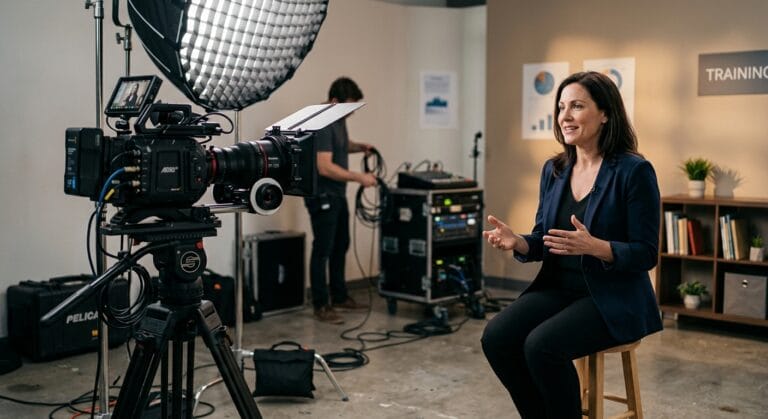
We criticize shortcuts that compromise the quality of the delivery. When we develop projects of Video for courses and distance learning., We focus on what holds an adult's attention. Intentional art direction, dynamic editing rhythm, and well-directed real instructors in the studio or on location.
We've applied artificial intelligence to our post-production line to gain speed and technical efficiency. But the focus on screen remains on humans. B2B business and high-level training are built on people talking to people.
If you've realized that ineffective training is sabotaging your skills development strategy and you want to truly engage your team with high-quality training, we need to help. to talk. Creating an online learning platform that employees don't skip takes work, but we know exactly how to do it.
Request a Quote