

Understand how corporate e-learning video production differs from higher education video lessons in terms of pacing, scene direction, and set design.
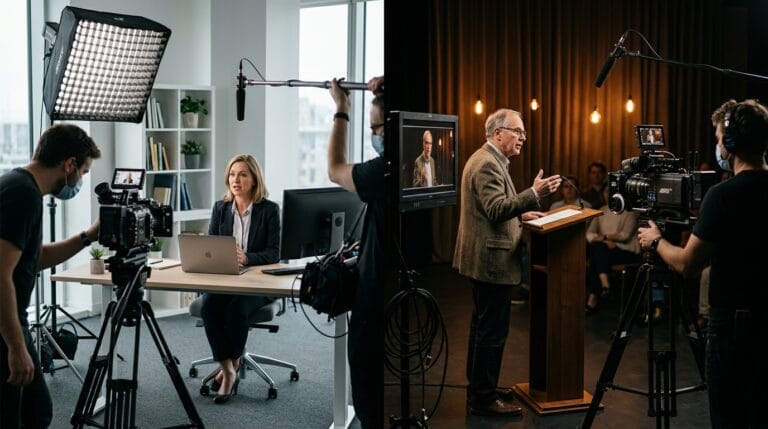
You are tasked with structuring your company's corporate university. The team's initial idea is to look at how major universities record their lectures and replicate that model internally.
The result? The training completion rate plummets by the second module. Your employee simply abandons the browser tab to respond to a client on Slack.
Copying academic aesthetics into the business environment is a structural error. Corporate e-learning video It solves the immediate pain points of the operation. A video lesson for higher education builds a deep theoretical foundation. Audiovisual engineering needs to keep pace with this stark difference in purpose.
Content production is not a one-size-fits-all assembly line. The graduate student paid for the course and needs the diploma. Their screen time allows for much greater tolerance for lengthy reflections.
In higher education, the content dictates the pace. Twenty- or thirty-minute lectures are common because the professor needs to develop complex reasoning. Here, the editing focuses on maintaining a fluid cadence over time.
To do this, use a setup. multi-camera In academic recording, this is fundamental. It allows the editor to switch angles during dense explanations, preventing visual fatigue in the student after fifteen minutes of class.
In the business world, the paradigm is turned upside down. Your sales coordinator watches the onboarding process between meetings. He's looking for a tactical solution to apply to the CRM immediately.
The corporate format demands quick cuts and dynamic framing. e-learning video production at scale For corporate teams, embrace microlearning with blocks of three to five minutes. The final cut eliminates theoretical fat.
The spokesperson's conduct on set changes drastically depending on the project's objective. University professors and masters are accustomed to the stage. They gesture, walk, and master classical oratory.
In this scenario, the role of the audiovisual director is to curb theatrical excesses. They help the specialist focus their gaze on the lens, creating intimacy with the student isolated on the other side of the screen, instead of lecturing to an invisible audience.
In corporate video, the spokesperson is usually a technical leader or area director. They have a deep understanding of the product, but often freeze when the camera's red light comes on.
The directing technique in the B2B studio focuses on reducing the cognitive load for non-actors. The strategic use of teleprompter Using bullet points or bullet points ensures training accuracy without disrupting the executive's natural flow.
The art direction of a digital postgraduate program demands an aura of undeniable authority. It's common to construct dark and elegant environments, inspired by masterclass aesthetics, with depth of field and dramatic lighting.
The focus is on giving institutional weight to the message. The graphic package acts as a refined virtual whiteboard. It subtly maps academic concepts and theories while the professor conducts the lesson.
In the training video production In a corporate setting, the environment needs to reflect the culture of your business. Brands prefer well-lit environments, clean backgrounds, or elements that directly evoke a modern and agile office.
The visual elements on the screen also change function. They become highly pragmatic, displaying screenshots of systems, process flowcharts, or sales checklists. Usability dominates the design.
Understanding the precise boundary between academic depth and corporate agility is what defines the success of our technical delivery. We adapt the audiovisual workflow according to the target audience.
When +A Educação and Fundação Dom Cabral needed in-depth material for their postgraduate programs, we designed a high-value-added ecosystem.
THE collection of over 600 video lessons It was delivered in a masterclass format. The set design was impressive, the lighting created contrast, and the graphic design helped retain the audience during the lengthy explanations.
On the other hand, when the learning challenge is agile and integrated into everyday tech life, our audiovisual engineering is transformed. That's what we did in partnership with CoolHow to train the Thoughtworks teams.
We created more than 90 training videos in microlearning format. The direction was straightforward, the setting vibrant, and the pacing perfectly suited for quick and practical consumption.
Whether you're training market leaders with university credentials or developing your operations team for new software, the filming method can't be the same. Standardized filming methods destroy engagement on your platform.
Your learning hub shouldn't become a repository of tiresome and disconnected videos for your audience. You need a team that designs the camera flow and editing with the exact course completion metric in mind.
Send our team a briefing and we'll discuss the best aesthetic for your catalog. Talk to Silvertake Video and discover the ultimate production model for your educational challenge.
Request a Quote