
Understand why multi-camera interviews are the standard for B2B testimonials. Discover how to structure angles, lenses, and protect your editing suite.
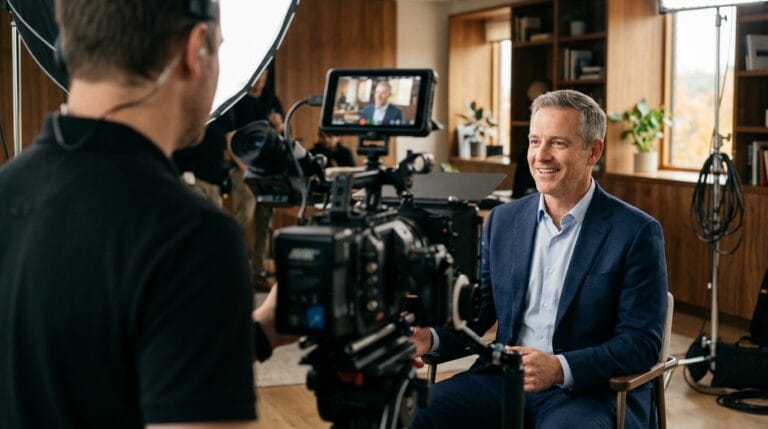
You position the camera, adjust the key light, and press REC. The company director begins to speak. The reasoning is excellent, the strategic message perfectly matches the briefing, but in the middle of a long sentence, he stumbles over a word, apologizes, and resumes his train of thought. During editing, the structural problem appears: how to cut this small error without creating a bizarre visual jump on the screen? The amateurish solution is to apply a smooth cross-dissolve that screams poor editing or to accept a crude jump cut that completely breaks the viewer's immersion. The error is not with the spokesperson, nor with the editing software. The error occurred in the set planning.
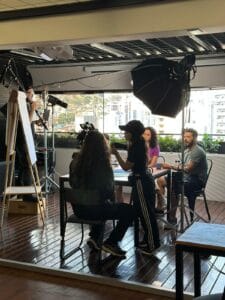
Treating corporate testimonials as a static monologue captured from a single angle is to lower the impact of your B2B communication. When you adopt the multi-camera for interviews, The technical game changes completely. The use of two or more simultaneous angles is no longer an exclusive feature of cinema or major documentaries, but has become the mandatory technical basis for anyone who needs to capture the attention of professionals and decision-makers.
Staring at the same shot for three uninterrupted minutes, without any variation in scale or perspective, forces the viewer's brain to shut down. The pace of the piece drops dramatically. Adding supplementary lenses to the set is not just an aesthetic choice to make the image prettier. It is, above all, a technical insurance policy. With multiple angles recording simultaneously, you gain absolute freedom in post-production to speed up the pace, emphasize a strong statement by closing in on the interviewee's face, and invisibly mask any hesitation.
Building a robust set isn't just about scattering equipment around the room and pointing it at the CEO. There's a precise geometry that dictates the tone and flow of the final product. The technical operation demands optical coherence so that the cuts work perfectly to the audience's eye.
The A-Camera is the backbone of your video. It sets the tone for the interview and establishes the spatial relationship between the interviewee and the environment. Standard and correct positioning requires it to be as close as possible to the interviewee's eye line, capturing them head-on, but with a slight angle depending on where the director or journalist is sitting off-screen. The ideal lens for the A-Camera typically ranges between 35mm and 50mm focal lengths. It not only frames the subject from the waist or chest up, but also delivers crucial visual information about the background, whether it's a modern factory lobby, a meeting room, or a controlled studio set.
If Camera A provides the context and setting, Camera B brings the detail and emotional intensity. The golden rule in multi-camera shooting is to ensure that the angles and focal lengths between the cameras are clearly different. Placing two cameras too close together with similar lenses results in the dreaded dirty cut, which bothers the viewer's brain. Camera B should be strategically positioned, operating with a longer lens, such as an 85mm or even a 135mm. The goal is to achieve a much closer shot, detailing facial expressions and gaze. When the executive makes a dramatic pause to reveal the quarterly results, the editing will cut to Camera B. And, tactically, it is this close-up angle that saves the narrative when we need to skip entire sections of speech.
For premium productions that demand an even higher aesthetic and narrative level, the third camera comes into play. It is usually positioned at a more extreme side angle, almost at a 90-degree profile, operated manually or supported by a motorized slider to create smooth, continuous, and elegant movement. The C-Camera injects a highly cinematic atmosphere and breaks the monotony of direct dialogue, functioning as an almost voyeuristic point of view within the corporate video.
Positioning the cameras is only the beginning of the technical work. The physics of recording interviews demands discipline with the direction of the gaze. The famous 180-degree rule dictates that all cameras must remain on the same side of the imaginary line connecting the interviewee to the interviewer. Breaking this axis makes it seem, in editing, that the executive is looking in opposite directions in each cut, spatially confusing the viewer and destroying the credibility of the testimony.
Lighting also undergoes a metamorphosis when we multiply lenses. Brightly illuminating a single front camera is simple. However, designing light for a multiple setup requires sculpting shadows and contrasts that work well in both wide and close-up shots. The key light and fill light need to encompass all lenses, while preventing tripods and lighting modifiers from spilling into the frame of Camera A.
Rigorous technical execution on set paves a smooth and unobstructed path in post-production. For cameras to communicate quickly in the editing suite, color space alignment and synchronization are vital. Using cameras with the same sensor family and clapping at the start of the take ensures that video and audio tracks align instantly with a click in Premiere or DaVinci Resolve.
The freedom of editing becomes immeasurable. Suppose your expert has given a rich ten-minute technical explanation, but the distribution strategy requires a dense two-minute cut for LinkedIn. Condensing this material with just one angle would create a festival of amateurish visual interruptions. With multiple angles, the editor extracts the definitive phrases and disguises the removal of pauses by alternating between cameras. The time jump disappears. The audience's brain accepts the change of perspective as a natural breather in the narrative.
Knowing how to apply this technique eliminates nervousness on set. The directing team doesn't need to stop the interview every time the expert makes a mistake. This psychological comfort for the person in front of the camera is the reason why mastering this technique is so important. executive direction in video This goes hand in hand with technical support. Furthermore, sound engineering works in tandem: lavalier and boom microphones operating on isolated audio channels prevent any sound jumps when visual cuts occur. Precise control of the environment dictates... How to improve audio quality in videos. and it solidifies the professional tone of the final deliverable.
Our directors and camera operators treat testimonies and statements as high-value assets, delivering pieces with the aesthetics of a directed documentary. All the technical formatting of a institutional video Focused on spoken word, it is constructed to isolate and protect brand authority.
An example of the clarity and agility generated by this structure was the series we developed for Company 1. The tactical objective was to produce a robust... video case Anchored exclusively in testimonials from clients and partners captured on location. Using a solid A and B camera setup, we were able to have the main camera establish the visual weight of the environment and the interviewee's role, while the secondary camera allowed the editor to stitch together the most precise answers, generating direct, to-the-point material with a contemporary rhythm and without narrative fat.
Another scenario where technical coverage multiplied the impact of the result was in recent projects for Matific. The mission required capturing success stories Documentaries featuring professionals and educators in schools. Experts often freeze in front of the lights and feel the pressure to say everything perfectly on the first try. The multi-camera set acted as our safety net: we conducted the conversation in a relaxed way, knowing that the different angles of coverage would give us the invisible scissors to extract only the essence and enthusiasm of the testimony in the editing room.
If your organization's corporate audiovisual department still insists on positioning a fixed camera in the corner of the table, hoping the spokesperson will speak perfectly for three minutes without blinking, your communication is obsolete. The strategic use of multiple lenses makes all the difference between an amateur video message and a polished, fluid executive narrative designed to capture attention and generate conversions. The complexity of aligning sensors, lights, and framing rules is entirely the responsibility of the production company. For your team and your leaders in front of the camera, the experience needs to be as easy and human as a good hallway conversation.
Your brand can no longer afford to lose attention with slow and rigid videos. Bring your vision and your audiovisual challenge to our team. Send us your brief and together we'll build the strategic quality of your next piece of content.
Request a Quote