
Learn how to direct executives on video in a natural and stress-free manner, ensuring the professionalism and authority your brand demands.
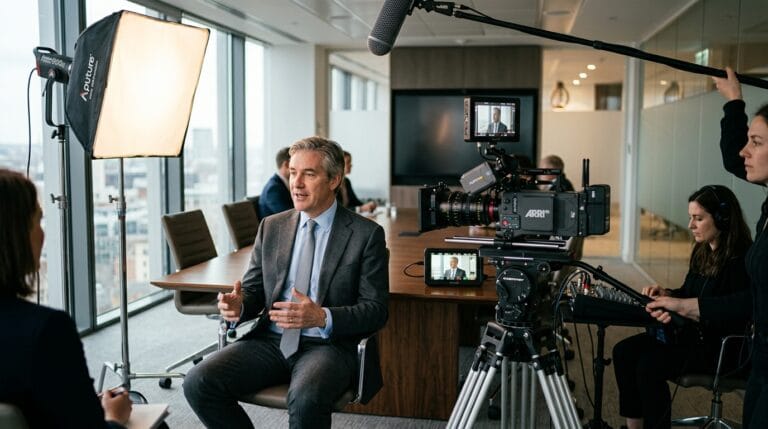
The scene is classic and haunts nine out of ten B2B marketing managers. You spend weeks aligning the company president's schedule, reserve a precious forty-minute window, hire a production company, and set up an impeccable camera setup in the main meeting room. The executive sits in the chair, the light comes on, and suddenly, that charismatic and articulate leadership disappears. In its place emerges a monotonous voice, rigid shoulders, and a fixed gaze that seems to be reading a cold report. Knowing how managing executives In video, the difference lies between a truly authoritative stance and content that feels artificial, stiff, and soulless.
The problem isn't a lack of communication skills on the part of your spokesperson. Directors, superintendents, and CEOs are used to leading board meetings, speaking to hundreds of employees, and closing multi-million dollar deals. However, the camera lens has a peculiar psychological effect: it acts as a microscope for insecurities. When the focus narrows, the executive's instinct for self-preservation is to shield themselves, adopting an excessively corporate posture that negates any trace of spontaneity and human connection.
If your company needs to produce a institutional video Whether it's a strategic brand positioning, the game isn't won solely through the technical quality of the cameras or perfect lighting. It's primarily decided by the psychology of the directing.
The first impulse of a cautious marketing team is to deliver a script with every word the executive should say. It seems safe, but it's a trap that almost always results in a robotic video. Unless your executive is a professional actor with years of theater experience, trying to memorize a text will cause them to expend all their brainpower trying to remember the next word, instead of conveying the message with the necessary conviction.
Instead of delivering a continuous text to be read from beginning to end, structure the outline in... key message blocks. The secret to corporate video communication isn't the surgical precision of every comma, but rather delivering the strategic vision with the right energy. When the director uses their own words to explain a concept they master, the tone of voice changes, body language relaxes, and natural authority organically reappears.
The teleprompter (TP) is often seen as a lifesaver in recordings with senior leadership. It has its uses, especially in official internal compliance communications, financial results reports, or project announcements. training video High precision is required, where legal terms and numbers cannot vary. However, incorrect use of the equipment creates the dreaded "scanning gaze"—when the presenter's eyes visibly move from left to right, revealing their reading to the viewer.
If the use of TP is indispensable for your project of video marketing, Apply three practical rules on set to soften the reading effect:
If you want to extract the best testimonial from your spokesperson for company videos, The interview format often surpasses the direct-to-the-camera speaking format. The key lies in the physical positioning of the person conducting the conversation on set.
The interviewer should sit directly next to the camera lens, at the same eye level as the executive. This establishes what we call... natural eye direction (or eyeline). The director or president is no longer speaking to a cold, black piece of glass; he is conversing with another person. The technical team takes care of the framing while the director conducts a genuine dialogue, asking provocative questions that stimulate complete, fluid, and dynamic responses.
At the start of filming, the golden trick is to ask simple questions that are completely off-script. Asking about traffic, travel schedules, or the executive's latest pet project helps to adjust the audio recording level and, most importantly, to loosen facial muscles before the cameras start recording official business messages.
This is an uncomfortable truth, but fundamental to the success of the project. There is an invisible hierarchy within organizations. However friendly and open the corporate environment may be, it is extremely difficult for a marketing manager or communications coordinator to give direct and corrective feedback to the company president or director on the set without creating an atmosphere of discomfort or excessive self-criticism on the part of the executive.
This is precisely where the role of an external and specialized directing team comes in. A neutral director has the technical authority to interrupt a take, subtly request a change in tone, and extract the best performance from the leader without the political weight or hierarchy of the company interfering in the process. The marketing team assumes the role of guardian of the institutional message, while the production company takes on the responsibility of refining the spokesperson's performance on set.
When planning your brand's next audiovisual production, analyze how your production partner approaches this critical stage of preparation and executive direction in their work. complete portfolio. Human direction on the set is just as important to the final result as the final camera resolution or the editing process.
Filming with your company's leadership doesn't have to be a stressful and exhausting experience. With the right script structure, the appropriate technical approach on set, and experienced directors who can read signs of discomfort and navigate them naturally, the process becomes fluid, and the final result reflects the true stature and authority of your brand in the B2B market.
If your company needs to structure testimonials, success stories, or institutional positioning that naturally highlight your directors and executives, we can help you on this journey. Visit our page on contact to tell us about your project needs or, if you prefer, take the opportunity to schedule a meeting Get in touch quickly with our technical team. Together, we'll build a narrative that does justice to the strategic importance of your business.
Request a Quote