
Understand how to align expectations in your company's video production. Discover a practical method to avoid rework, missed deadlines, and budget overruns.
There's a myth in B2B marketing that approving an audiovisual piece is simply a matter of watching the final cut and pointing out what you don't like. If your process operates on that premise, losses are imminent.
Delaying project evaluation until the edited version arrives consumes the budget. When the marketing team lacks clarity on the stages, the campaign is delayed and the relationship with the production company suffers.
The management of expectations in video production This is what structures a functional deliverable. In the rush for results, managers end up skipping scope validations.
They approve conceptual ideas in short meetings and expect immediate results in the editing process. The audiovisual workflow takes a heavy toll for each technical change requested outside of the planned schedule.
The biggest production bottlenecks are procedural. An executive director might ask to change the location after the breakdown has been approved, or the marketing team might decide to change a statistic after the narrator has already delivered the voice-over.
These issues arise when the internal client is unaware of how the process works. To scale corporate content, companies need to structure the validation phases.
Predictability requires a four-step approval workflow. The model defines what company decision-makers need to evaluate at each specific point in the timeline.
Treating the initial document as a brainstorming session disrupts the project. The briefing functions as a technical contract that defines the format, duration, visual identity, and distribution channels.
The message validation by management occurs at the start. To avoid rework, the team needs to... qualify the video briefing in detail.
Changing a single line of text in the script document has no extra financial impact. Changing that same line after the professional has recorded in the studio requires scheduling a new day of crew, camera, and lighting.
The time to point out errors in the content is in the text itself. We have established... SLAs and video production deadlines The exact timeframe between the delivery of this written version and the recording date.
Internal clients may find the first version unusual. The image appears without color grading, the soundtrack is not leveled, and the ambient audio still contains bleed.
The rough cut serves to validate the narrative order and pacing. Teams must analyze specific aspects of each phase to approve the logical progression.
| Editing Phase | What should be evaluated? | What is not yet ready? |
|---|---|---|
| Rough Cut | Story structure, dialogue selection, and pacing. | Color grading, mixing, and motion graphics |
| Fine Cut | Soundtrack, text animations, and transitions | Final audio mastering |
| Finalization | Verification of specific technical errors. | – |
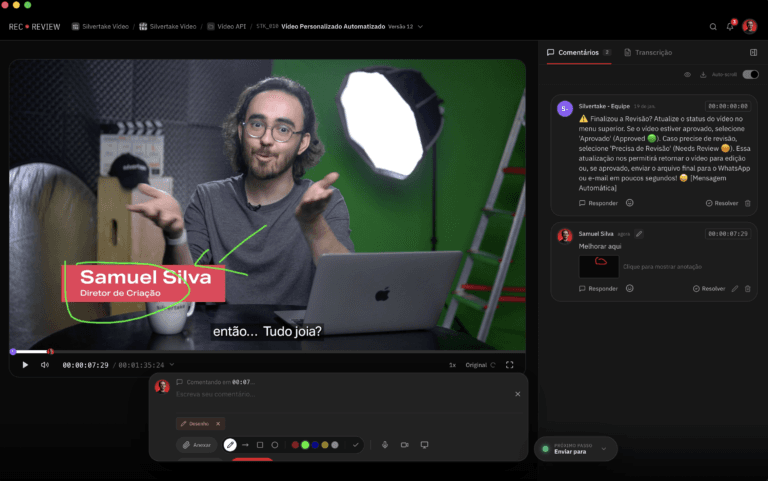
There's no corporate budget that can sustain an audiovisual project into its fifteenth version. The rule in post-production is to consolidate change requests into a few rounds.
Marketing, HR, and management should send a single document with the unified edits. A workflow of video versioning It prevents one leader from requesting to include a scene while another requests its removal in the same file.
Transparency in processes keeps the schedule under control. We apply this operational cadence to the creation of any... institutional video focused on conversion or branding.
The development of advertising campaign for the Bernoulli Education System This illustrates the execution. The scope included two locations, four scenarios, and the delivery of 60-second and 30-second clips.
The production window lasted 30 days until final delivery. Aligning on the scope prior to going on set allowed the material to be delivered within the school's schedule, without any improvisation during filming.
The progress of a project requires that approval rules be clear from the moment the contract is signed. With defined boundaries, the team gains predictability and the brand receives the material on time.
Want to record your company's campaign using a method that respects your budget? Send us your challenge and... Talk to the Silvertake team..
Request a Quote