
Understand how to structure an internal video communication framework to engage distributed teams, reduce unproductive meetings, and strengthen your culture.

The scene repeats itself every week. The board has an important announcement for the entire company. The team is divided between headquarters, regional branches, and employees working from home. The first option that comes to mind is to call a general meeting on Zoom. The result? Blocked agendas, dozens of cameras turned off, and message retention that approaches zero. The second option is to send a long, formal, and dense email. The internal open rate rarely exceeds 30%. When the subject is Internal video communication, The most common mistake companies make is treating audiovisual content as an occasional luxury, rather than as a strategic tool for asynchronous alignment.
If your company operates with distributed teams, mandatory synchronous communication is killing your productivity. Forcing hundreds of people to stop their tasks simultaneously to listen to a tactical message is costly. On the other hand, allowing organizational culture to cool down due to geographical distance is an incalculable risk for HR and Corporate Communication. B2B video fills exactly this gap. It carries the empathy, tone of voice, and facial expression of a face-to-face conversation, but respects the time and routine of those on the front line.
The challenge, however, isn't deciding to press RECORD. The challenge is consistency. Recording one brilliant video a year doesn't build culture. Making haphazard, homemade videos destroys the perceived authority of leadership. To solve this equation, you need a scalable process. You need a framework.
Treating the creation of corporate videos for internal audiences in isolation is asking for missed deadlines and budget overruns. To prevent your communications team from becoming reliant on improvisation, production should be broken down into four structural areas.
Not every video requires a film crew, but strategic videos can't look like a phone call. The first step in your framework is to classify the demand.
Tactical videos encompass weekly updates, new software processes, or agile operational announcements. They can be produced with a leaner structure. Cultural videos, on the other hand, require more depth. We're talking about... institutional video Annual goals, diversity campaigns, new employee onboarding, and brand manifestos. These materials shape how employees perceive the company that pays their salary.
A practical example of cultural impact is the work we developed for the Baptist Education Network. The challenge was to unify the message and mission for dozens of units spread across Brazil. We produced a manifesto video that connected all the centers under the same visual and narrative umbrella.
You can check the technical details and locations at Complete case study of the Baptist Network.
The employee working from home constantly competes for their own attention with dozens of open browser tabs and Slack notifications. If your CEO records a 15-minute video in a single take, it will be abandoned before the third minute.
Format dictates engagement. Adopt a direct approach. Get straight to the point in the first ten seconds. If the content is dense, break it down. Transforming a long update into bite-sized pieces consumes less cognitive energy from the viewer and drastically improves retention. It's the same logic that makes... Is video microlearning so effective?. A line of reasoning packed into three minutes works infinitely better than an endless monologue.
The third pillar of the framework is preparing those who will be in front of the camera. Executives and managers are excellent at negotiation tables, but they tend to freeze when a film camera is turned on. Their body language becomes rigid, their speech sounds rehearsed, and the message loses exactly what video aims to deliver: human connection.
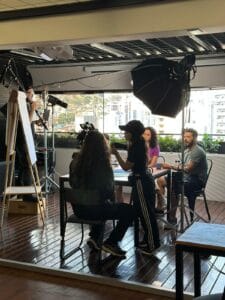
Within your internal communication process, there should be a directing protocol. Avoid rigid, word-for-word scripts if the executive is not technically familiar with teleprompters. Opt for key topics and conduct the recording in an interview format. If you want to understand how to get the best out of your management team on set, see our material on [topic]. How to direct executives on video without freezing the recording.. The recording technique changes everything.
Your video was planned, filmed, edited with impeccable graphics, and exported. Where will it end up? Uploading the raw file to a folder on the company drive and hoping people will click on it is a waste of money.
The final pillar of the framework requires a distribution path. Use the corporate intranet, send the link through official channels, and measure the results. Understanding until what minute people watched and at what point they abandoned the video will provide feedback for your next production. Vanity metrics don't matter here; what matters is the message's penetration within the operational base. Tracking the right metrics completes the cycle, as we discussed in the post about... B2B video distribution and measurement.
Mature companies know that decentralizing knowledge also requires standardization. When Arco Educação needed scale and quality to train its internal audience through Arcolab, the challenge was clear: to create training videos that they were quick to produce, maintained a dynamic tone, and respected a modern visual identity.
We took the lead on this. Arco Educação's corporate training project Structuring the aesthetics, ensuring the technical quality of the audio and image in record time, and offering material that employees actually wanted to consume, eliminating the barrier of distance between teams.
Continuing to rely on mandatory corporate texts that nobody reads is not a sustainable strategy for keeping your team on the same page. Internal video communication restores clarity and human warmth to leadership-team interactions, provided there is industrial planning behind the scenes.
Having an audiovisual partner who understands the corporate environment and can get the best out of your spokespeople is the game-changer between an exhausting project and an efficient production pipeline. Gather the demands from your internal calendar and bring them to our team for evaluation. Consider scale, aesthetics, and retention.
Ready to professionalize your end-to-end team communication? Send us your project needs and speak with our experts through our page. contact.
Request a Quote