
Learn how to capture audio in a noisy office using professional techniques, the right microphones, and environmental control.
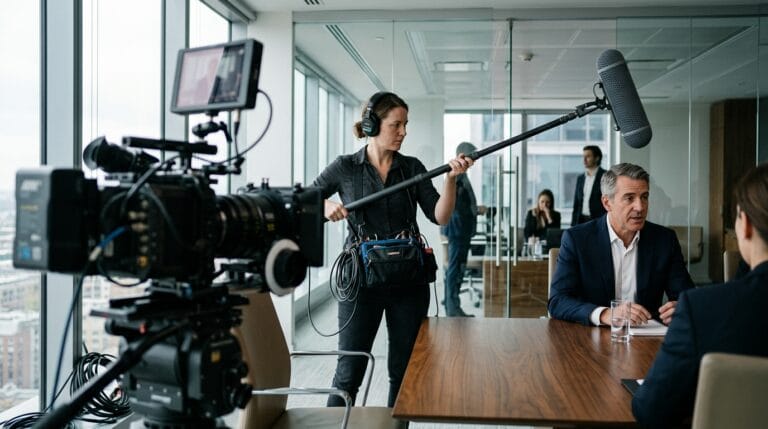
You frame the director perfectly with the glass wall in the background. The lighting is impeccable. Then, you put on your headphones to check the sound.
The air conditioning sounds like a jet engine. The sales team next door rings a bell to celebrate a goal. The avenue traffic spills out the window.
THE audio recording in a noisy office It's a corporate production nightmare. If the sound is bad, the 4K image is absolutely useless.
In B2B, the viewer might forgive a slightly imprecise framing. But they'll abandon the video within the first three seconds if the spokesperson's voice sounds distant, muffled, or echoes.
Controlling acoustics in corporate spaces is almost impossible most of the time. You need to adapt the technical setup to the routine chaos of the company environment.
The number one rule of audio recording is proximity. The microphone needs to be as close as possible to the sound source.
A wireless lapel microphone, neatly concealed in the executive's tie or blazer, is the first line of defense. It isolates the main voice and significantly minimizes routine background noise.
However, lapels can pick up the rustling of the fabric if the interviewee gestures a lot in their chair. Therefore, professional teams never rely on just one channel.
The simultaneous use of a directional (shotgun) microphone on a boom pole is mandatory. Positioned just above the frame and pointed directly at the speaker's chest, it rejects off-axis noise.
This microphone cuts out background noise and focuses exclusively on voice frequencies. To better understand this balance between equipment, we detail the options in the guide on... microphones and recording environments on our blog.
You can't stop street traffic, but you can turn off the air conditioning in the room. Don't try to fix in post-production what you can silence on the film set.
Ask building maintenance to pause the ventilation on that floor for twenty minutes. Unplug the mini-fridge. Put a sign on the door warning about the ongoing recording.
These are essential details that are resolved in the following stages of what happens before pressing REC. Negotiating corporate silence requires a proactive and technically sound approach from the production team.
Modern meeting rooms are veritable echo chambers. Glass walls, granite tables, and cold floors reflect the speaker's voice in all directions.
To break up this reverberation, the technical team sets up heavy acoustic blankets supported by lighting tripods, positioned just outside the frame. They absorb the sound waves before they hit the glass and return blurred to the microphone.
Even with the perfect recording technique, an unpredictable noise like high heels in the hallway can leak into the ideal take. Today, advanced noise reduction tools can isolate compromised frequencies impressively.
But there's a fine line here. Aggressively processing the audio leaves the executive's voice sounding robotic and breathless. The original recording needs to be solid so that the software only needs to smooth out the subtle rough edges.
The production of a institutional video Focused on business, it demands operational fluidity. The executive doesn't have time to repeat the same speech five times because a phone rang in the background of the next cubicle.
Our recording teams always operate with structural audio redundancy. We record simultaneously on lavalier and directional microphones, ensuring that the editor has clean and safe files in the mixing suite.
It was precisely with this approach that we captured the Matific case study videos. We recorded authentic testimonies from coordinators and teachers working within active schools.
The sound engineering there needed to isolate the educators' voices from the inevitable and unpredictable noise of students in the hallway, without losing the texture of the environment.
The same rigor with voice processing was applied to Marsh manifesto video. Carefully crafted interviews are what truly underpin the credibility of the message in executive campaigns.
Poor audio ruins high-impact messages. Don't treat your company's sound as a secondary technical detail.
If you need to record clean testimonials and corporate campaigns with no room for technical error, work with someone who masters the logistics of on-set shooting. Send your briefing to Silvertake. And we will detail the strategy of your project.
Request a Quote