
Discover how to structure the technical dubbing process with AI to distribute your corporate videos globally while maintaining professional quality.
This scene is common in the boardrooms of large companies. You have just approved a institutional video Or a dense corporate training session, which was visually impeccable and perfectly aligned with the message in Portuguese. The next day, headquarters demands that this same material be distributed to branches in Mexico, the United States, and Germany. The deadline is tight, and the budget doesn't allow for renting international studios.
Until very recently, solving this equation required redoing a large part of the sound design: finding native speakers, dealing with accents, re-recording soundtracks, and trying, often unsuccessfully, to fit foreign dialogue into the mouth of a Brazilian spokesperson. Today, the market tries to sell you a magic solution. Just upload the file to a tool... AI-powered dubbing, Press a button and download the finished video in thirty languages.
Technical reality, however, takes its toll right from the first test. The automated tool doesn't understand the context of your corporate jargon. It distorts the background audio, chews up the spokesperson's breathing, and returns a video of your CEO speaking English, but with a vocal inflection bordering on the ridiculous. If the goal of the video is to convey authority, using a one-click solution destroys precisely the credibility you spent weeks building.
To produce videos in other languages to reach global audiences By using artificial intelligence, you need to stop viewing AI as a social media filter and start treating it as an advanced post-production step in audio and video.
The first waves of text-to-speech (TTS) tools operated on a simple script-reading logic. The result was mechanical and disconnected from the original emotion. What we call professional-level AI dubbing today involves much deeper processes: zero-shot cloning of the original voice and lip-sync modification.
This means that the software listens to the timbre, roughness, and cadence of the director in front of the camera and attempts to reproduce these same sound characteristics when generating the foreign language. Furthermore, image processing algorithms manipulate the pixels around the spokesperson's mouth to match the phonemes of the new language. The concept is revolutionary, but the raw execution generates visual artifacts and sound distortions unacceptable for high-end companies.
Scaling this process with quality requires the audiovisual production company to create a pipeline of separation, adaptation, and reconstruction. This workflow is what separates a low-quality video from a premium corporate delivery.
The biggest mistake people make when trying to dub using artificial intelligence is uploading the finished video, the one where the voice, music, and sound effects are compressed into a single layer. When the AI tries to translate and replace the voice, it inevitably blurs the background music or swallows the transition effects.
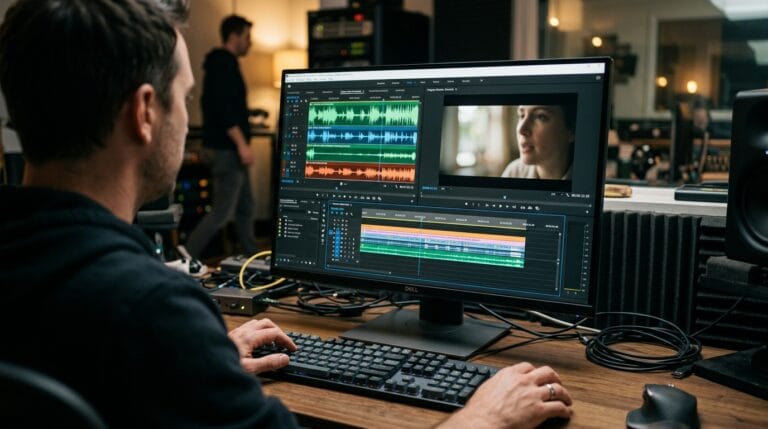
The correct process requires the editor to export the files separately. We need one track with only the clean voices (Dialogue) and another track containing exclusively the music and sound effects, known in the film industry as M&E (Music and Effects). In this way, We guarantee impeccable audio quality., This is because the AI only processes the voice, leaving the original soundscape intact for final reconstruction.
Artificial intelligence transcribes and translates in seconds, but it lacks common sense. Structurally, Portuguese requires fewer syllables for certain expressions than German, for example. If an executive takes 5 seconds to explain a concept in Portuguese, and the German translation requires 8 seconds of text, the AI tool will speed up the artificially cloned voice to try to "fit" the speech into the existing screen space.
The result is an executive speaking at the speed of light. To avoid this, the human scriptwriting stage is non-negotiable. A reviewer needs to trim the translated text, choosing shorter synonyms or restructuring the sentence to ensure that the number of syllables in the target language is equivalent to the length of the original video clip.
Even with cloned voices, dubbing software often ignores the biological nature of speech. They cut out breaths, sighs, and small pauses for thought, generating a continuous and exhausting audio. During post-production, the audio engineer needs to intervene in the cadence, restoring the "blank spaces" to the cloned voice file. It is these micro-pauses that convince the viewer's brain that the audio was recorded by a human being in a real studio.
AI-generated lip-syncing is visually aggressive if viewed uninterrupted for too long. No matter how powerful the software, the mouth may suffer from minor blurring, especially if the speaker turns their face or gestures in front of their chin.
The solution in the editing suite is technical: we use the masking rule (B-roll). We insert cover scenes, titles, motion elements, or strategic camera cuts precisely at the moments when the AI lip-syncing loses its naturalness. You hear the perfectly translated audio, but the visual aspect disguises the limitations of the technology, maintaining the rhythm without distracting the target audience.
AI-powered localization is a powerful tool for scaling. It shines in scaling training modules, system updates, global results communications, and operational videos where the retention of technical information is the central focus. In these areas, the agility to generate hours of content in five different languages surpasses classic audiovisual purism.
However, for highly impactful emotional manifesto videos, top-of-funnel campaigns, or television commercials, the traditional approach with professional voice actors from the target country still delivers the weight, artistic interpretation, and dramatic force that the machine cannot replicate with surgical precision.
At Silvertake, we don't treat the use of AI as a ready-made formula, but as an extension of our rigorous technical post-production. We know that the adoption of these technologies by B2B corporations requires predictability and brand security. When dealing with globally active clients, our team controls audio separation, reviews screen time equivalence, and ensures that industry jargon isn't butchered by a generic algorithmic translator.
A practical example of this union between classic audiovisual technique and the need for global scale was the work done for Tecnosulfur. We needed to translate steelmaking processes and complex compliance rules in a visual and universal way.
Tecnosulfur | Motion Graphics Code of Ethics
When working with scripts that would be distributed in five different languages, the care taken from pre-production to graphic design ensured that the essence of the content was delivered perfectly, respecting the corporate culture and technical particularities of each branch, whether through organically translated titles in the animation or the correct sound choice.
Approving a budget for a video in Brazil only to later discover that it has no potential for the rest of the world is a huge waste for any marketing or human resources department. AI-powered dubbing has come to shorten financial paths, but it demands twice the skill from those operating the machine.
You don't need to risk your company's credibility by testing software in isolation in production. If your current challenge is scaling the reach of your video ecosystem to teams and branches abroad while ensuring a television-quality standard, we know exactly how to design that workflow for you. Come have a technical chat about your next project with our team at [website/contact information]. https://silvertake.video/contato/.
Request a Quote